Examples
Cold bubble
The function
# src/Examples/cold_bubble.jl

function cold_bubble(;
    x_size::Integer = 40,
    z_size::Integer = 40,
    npx::Integer = 1,
    npz::Integer = 1,
    output_file::AbstractString = "cold_bubble.h5",
    prepare_restart::Bool = false,
    visualize::Bool = true,
    plot_file::AbstractString = "examples/results/cold_bubble.svg",
)
    lx = 20000.0
    lz = 20000.0

    rx = lx / 8
    rz = lz / 8

    atmosphere = AtmosphereNamelist(;
        background = :Isentropic,
        initial_rhop = (x, y, z) -> begin
            r = sqrt((x / rx)^2 + ((z - 3 * rz) / rz)^2)
            if r <= 1
                return 0.005 * (1 + cos(pi * r))
            else
                return 0.0
            end
        end,
    )

    discretization = DiscretizationNamelist(; dtmax = 60.0)

    domain = DomainNamelist(; x_size, z_size, lx, lz, npx, npz)

    output = OutputNamelist(;
        output_file,
        output_variables = [:thetap],
        prepare_restart,
    )

    integrate(Namelists(; atmosphere, discretization, domain, output))

    if visualize && MPI.Comm_rank(MPI.COMM_WORLD) == 0
        h5open(output_file) do data
            plot_output(plot_file, data, ("thetap", 1, 1, 1, 2))
            return
        end
    end

    return
end
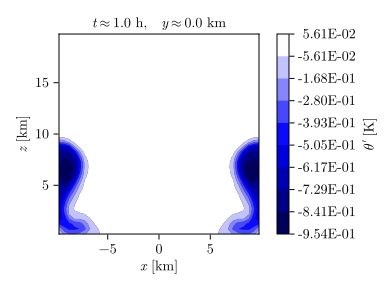
simulates a cold bubble in a 2D pseudo-incompressible isentropic atmosphere and visualizes the potential-temperature fluctuations after one hour integration time (see below).
Hot bubble
The function
# src/Examples/hot_bubble.jl

function hot_bubble(;
    x_size::Integer = 40,
    z_size::Integer = 40,
    npx::Integer = 1,
    npz::Integer = 1,
    output_file::AbstractString = "hot_bubble.h5",
    prepare_restart::Bool = false,
    visualize::Bool = true,
    plot_file::AbstractString = "examples/results/hot_bubble.svg",
)
    lx = 20000.0
    lz = 20000.0

    rx = lx / 8
    rz = lz / 8

    atmosphere = AtmosphereNamelist(;
        model = :Compressible,
        background = :Isentropic,
        initial_rhop = (x, y, z) -> begin
            r = sqrt((x / rx)^2 + ((z - 5 * rz) / rz)^2)
            if r <= 1
                return -0.005 * (1 + cos(pi * r))
            else
                return 0.0
            end
        end,
    )

    discretization = DiscretizationNamelist(; dtmax = 60.0)

    domain = DomainNamelist(; x_size, z_size, lx, lz, npx, npz)

    output = OutputNamelist(;
        output_file,
        output_variables = [:thetap],
        prepare_restart,
    )

    integrate(Namelists(; atmosphere, discretization, domain, output))

    if visualize && MPI.Comm_rank(MPI.COMM_WORLD) == 0
        h5open(output_file) do data
            plot_output(plot_file, data, ("thetap", 1, 1, 1, 2))
            return
        end
    end

    return
end
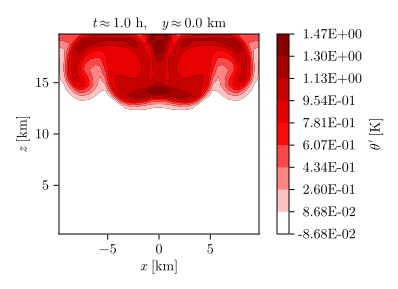
simulates a hot bubble in a 2D compressible isentropic atmosphere and visualizes the potential-temperature fluctuations after one hour integration time (see below).
Mountain wave
The function
# src/Examples/mountain_wave.jl

function mountain_wave(;
    x_size::Integer = 40,
    y_size::Integer = 40,
    z_size::Integer = 40,
    npx::Integer = 1,
    npy::Integer = 1,
    npz::Integer = 1,
    output_file::AbstractString = "mountain_wave.h5",
    prepare_restart::Bool = false,
    visualize::Bool = true,
    plot_file::AbstractString = "examples/results/mountain_wave.svg",
)
    h0 = 100.0
    l0 = 1000.0

    lx = 20000.0
    ly = 20000.0
    lz = 20000.0
    dxr = lx / 2
    dyr = ly / 2
    dzr = lz / 2
    alpharmax = 0.0179

    atmosphere = AtmosphereNamelist(;
        coriolis_frequency = 0.0,
        initial_u = (x, y, z) -> 10.0,
    )

    domain = DomainNamelist(; x_size, y_size, z_size, lx, ly, lz, npx, npy, npz)

    grid = GridNamelist(;
        resolved_topography = (x, y) -> h0 / (1 + (x^2 + y^2) / l0^2),
    )

    output =
        OutputNamelist(; output_file, output_variables = [:w], prepare_restart)

    sponge = SpongeNamelist(;
        lhs_sponge = (x, y, z, t, dt) -> begin
            alpharx =
                abs(x) >= (lx - dxr) / 2 ?
                sin(pi * (abs(x) - (lx - dxr) / 2) / dxr)^2 : 0.0
            alphary =
                abs(y) >= (ly - dyr) / 2 ?
                sin(pi * (abs(y) - (ly - dyr) / 2) / dyr)^2 : 0.0
            alpharz =
                z >= lz - dzr ? sin(pi / 2 * (z - (lz - dzr)) / dzr)^2 : 0.0
            return alpharmax * (alpharx + alphary + alpharz) / 3
        end,
        relaxed_u = (x, y, z, t, dt) -> 10.0,
    )

    integrate(Namelists(; atmosphere, domain, grid, output, sponge))

    if visualize && MPI.Comm_rank(MPI.COMM_WORLD) == 0
        h5open(output_file) do data
            plot_output(plot_file, data, ("w", 20, 20, 10, 2))
            return
        end
    end

    return
end
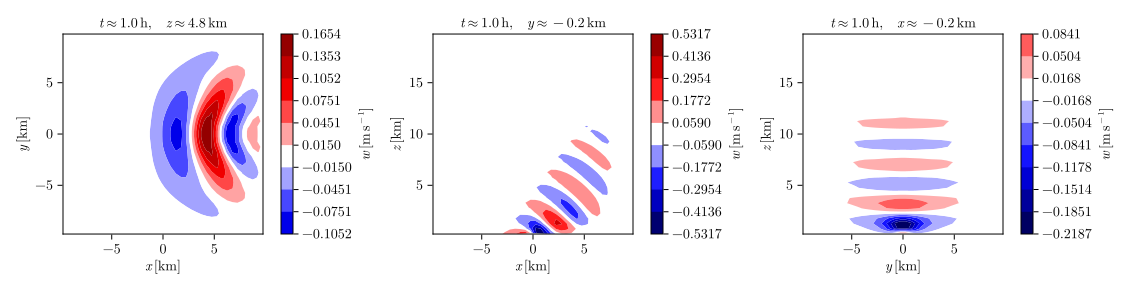
performs a 3D mountain-wave simulation. The surface topography is given by
\[h \left(x, y\right) = \frac{h_0}{1 + \left(x^2 + y^2\right) / l_0^2},\]
with $h_0 = 100 \ \mathrm{m}$ and $l_0 = 1 \ \mathrm{km}$. The atmosphere is isothermal, with the default temperature $T_0 = 300 \ \mathrm{K}$ and the initial wind $\boldsymbol{u}_0 = \left(10, 0, 0\right)^\mathrm{T} \ \mathrm{m \ s^{- 1}}$.
Reflections at the upper boundary are prevented by damping the generated mountain waves in a sponge defined by
\[\alpha_\mathrm{R} \left(x, y, z\right) = \alpha_{\mathrm{R}, \max} \frac{\alpha_{\mathrm{R}, x} \left(x\right) + \alpha_{\mathrm{R}, y} \left(y\right) + \alpha_{\mathrm{R}, z} \left(z\right)}{3}\]
with
\[\begin{align*} \alpha_{\mathrm{R}, x} \left(x\right) & = \begin{cases} \sin^2 \left[\pi \frac{\left|x\right| - \left(L_x - \Delta x_\mathrm{R}\right) / 2}{\Delta x_\mathrm{R}}\right] & \mathrm{if} \quad \left|x\right| \geq \frac{1}{2} \left(L_x - \Delta x_\mathrm{R}\right),\\ 0 & \mathrm{else}, \end{cases}\\ \alpha_{\mathrm{R}, y} \left(y\right) & = \begin{cases} \sin^2 \left[\pi \frac{\left|y\right| - \left(L_y - \Delta y_\mathrm{R}\right) / 2}{\Delta y_\mathrm{R}}\right] & \mathrm{if} \quad \left|y\right| \geq \frac{1}{2} \left(L_y - \Delta y_\mathrm{R}\right),\\ 0 & \mathrm{else}, \end{cases}\\ \alpha_{\mathrm{R}, z} \left(z\right) & = \begin{cases} \sin^2 \left[\frac{\pi}{2} \frac{z - \left(L_z - \Delta z_\mathrm{R}\right)}{\Delta z_\mathrm{R}}\right] & \mathrm{if} \quad z \geq L_z - \Delta z_\mathrm{R},\\ 0 & \mathrm{else}, \end{cases} \end{align*}\]
where $\alpha_{\mathrm{R}, \max} = 0.0179 \ \mathrm{s^{- 1}}$, $\Delta x_\mathrm{R} = L_x / 2$, $\Delta y_\mathrm{R} = L_y / 2$ and $\Delta z_\mathrm{R} = L_z / 2$. This sponge not only prevents wave reflections at the model top but also provides a damping at the horizontal boundaries. Moreover, it is configured such that the wind is relaxed towards its initial state, so that (in the ideal case) the periodicity in $x$ and $y$ is effectively eliminated by enforcing a constant wind at the domain edges.
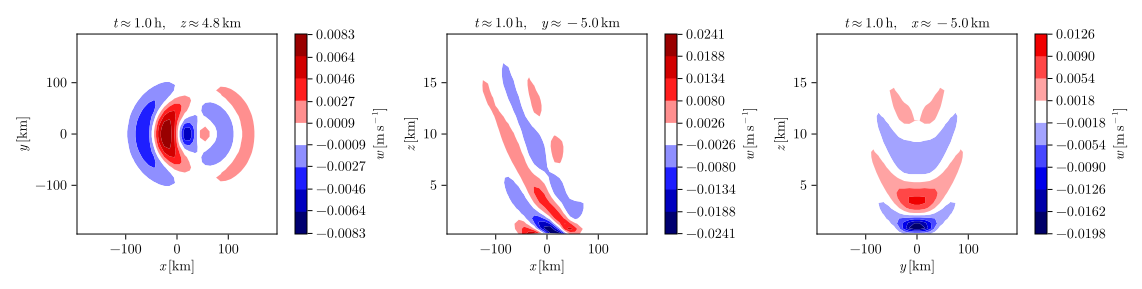
After the simulation has finished, the vertical wind is visualized in three cross sections of the domain (see below).
Vortex
The function
# src/Examples/vortex.jl

function vortex(;
    x_size::Integer = 40,
    y_size::Integer = 40,
    npx::Integer = 1,
    npy::Integer = 1,
    output_file::AbstractString = "vortex.h5",
    prepare_restart::Bool = false,
    visualize::Bool = true,
    plot_file::AbstractString = "examples/results/vortex.svg",
)
    lx = 20000.0
    ly = 20000.0

    rx = lx / 4
    ry = ly / 4

    atmosphere = AtmosphereNamelist(;
        model = :Boussinesq,
        background = :NeutralStratification,
        initial_u = (x, y, z) -> begin
            r = sqrt((x / rx)^2 + (y / ry)^2)
            if r <= 1
                return -5 * y / ry * (1 + cos(pi * r)) / 2
            else
                return 0.0
            end
        end,
        initial_v = (x, y, z) -> begin
            r = sqrt((x / rx)^2 + (y / ry)^2)
            if r <= 1
                return 5 * x / rx * (1 + cos(pi * r)) / 2
            else
                return 0.0
            end
        end,
    )

    domain = DomainNamelist(; x_size, y_size, lx, ly, npx, npy)

    output = OutputNamelist(;
        output_file,
        output_variables = [:chi],
        prepare_restart,
    )

    tracer = TracerNamelist(;
        tracer_setup = :TracerOn,
        initial_chi = (x, y, z) -> begin
            r = sqrt(((abs(x) - rx) / rx)^2 + (y / ry)^2)
            if r <= 1
                return sign(x) * (1 + cos(pi * r)) / 2
            else
                return 0.0
            end
        end,
    )

    integrate(Namelists(; atmosphere, domain, output, tracer))

    if visualize && MPI.Comm_rank(MPI.COMM_WORLD) == 0
        h5open(output_file) do data
            plot_output(plot_file, data, ("chi", 1, 1, 1, 2))
            return
        end
    end

    return
end
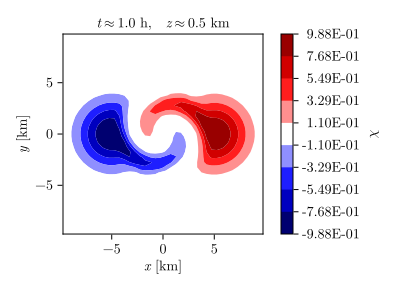
initializes two tracer disks and a vortex in a 2D horizontal Boussinesq atmosphere, integrates over one hour and visualizes the resulting tracer distribution (see below).
Wave packet
The function
# src/Examples/wave_packet.jl

function wave_packet(;
    x_size::Integer = 40,
    y_size::Integer = 40,
    z_size::Integer = 80,
    npx::Integer = 1,
    npy::Integer = 1,
    npz::Integer = 1,
    output_file::AbstractString = "wave_packet.h5",
    prepare_restart::Bool = false,
    visualize::Bool = true,
    plot_file::AbstractString = "examples/results/wave_packet.svg",
)
    lx = 20000.0
    ly = 20000.0
    lz = 40000.0

    parameters = (
        k = 16 * pi / lx,
        l = 16 * pi / ly,
        m = 32 * pi / lz,
        rx = 0.25,
        ry = 0.25,
        rz = 0.25,
        x0 = 0.0,
        y0 = 0.0,
        z0 = 20000.0,
        a0 = 0.05,
    )

    background = :Realistic
    coriolis_frequency = 0.0001

    atmosphere = AtmosphereNamelist(; background, coriolis_frequency)

    domain = DomainNamelist(; x_size, y_size, z_size, lx, ly, lz, npx, npy, npz)

    state = State(Namelists(; atmosphere, domain))
    (; g) = state.constants

    atmosphere = AtmosphereNamelist(;
        background,
        coriolis_frequency,
        initial_u = (x, y, z) -> real(
            uhat(state, parameters, x, y, z) *
            exp(1im * phi(parameters, x, y, z)),
        ),
        initial_v = (x, y, z) -> real(
            vhat(state, parameters, x, y, z) *
            exp(1im * phi(parameters, x, y, z)),
        ),
        initial_w = (x, y, z) -> real(
            what(state, parameters, x, y, z) *
            exp(1im * phi(parameters, x, y, z)),
        ),
        initial_pip = (x, y, z) -> real(
            pihat(state, parameters, x, y, z) *
            exp(1im * phi(parameters, x, y, z)),
        ),
        initial_thetap = (x, y, z) ->
            real(
                bhat(state, parameters, x, y, z) *
                exp(1im * phi(parameters, x, y, z)),
            ) / g * thetabar(state, x, y, z),
        buoyancy_initialization = :initial_thetap,
    )

    output = OutputNamelist(;
        output_file,
        output_variables = [:u, :v, :w],
        prepare_restart,
        output_interval = 900,
        tmax = 900,
    )

    integrate(Namelists(; atmosphere, domain, output))

    if visualize && MPI.Comm_rank(MPI.COMM_WORLD) == 0
        h5open(output_file) do data
            plot_output(
                plot_file,
                data,
                ("u", 20, 20, 40, 2),
                ("v", 20, 20, 40, 2),
                ("w", 20, 20, 40, 2);
                time_unit = "min",
            )
            return
        end
    end

    return
end
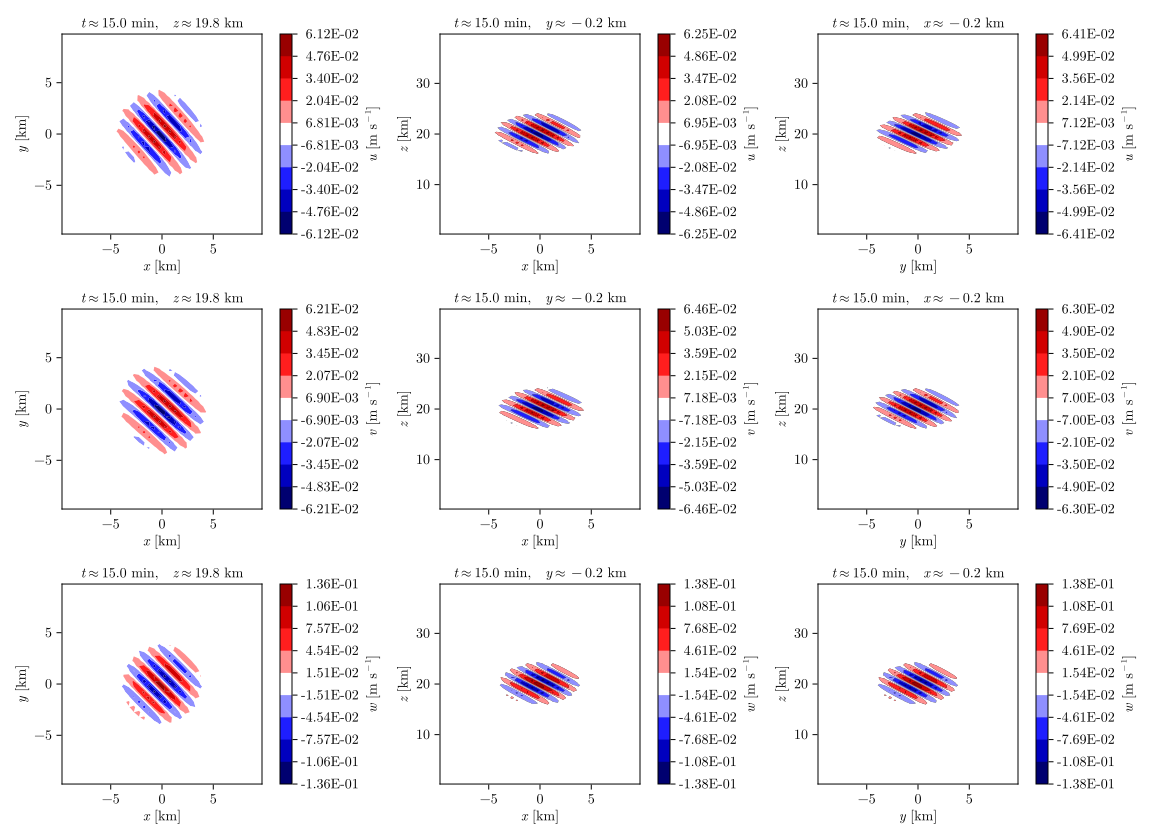
initializes a resolved gravity-wave packet in the stratosphere of a "realistic" atmosphere (isentropic troposphere and isothermal stratosphere) and visualizes the resulting wind after fifteen minutes integration time (see below). For the relatively complex initialization, this script first constructs an auxiliary state that contains the necessary background fields and then uses helper functions that implement the gravity-wave dispersion and polarization relations (organized in the module WavePacketTools and included in a section below).
WKB mountain wave
The function
# src/Examples/wkb_mountain_wave.jl

function wkb_mountain_wave(;
    x_size::Integer = 40,
    y_size::Integer = 40,
    z_size::Integer = 40,
    npx::Integer = 1,
    npy::Integer = 1,
    npz::Integer = 1,
    output_file::AbstractString = "wkb_mountain_wave.h5",
    prepare_restart::Bool = false,
    visualize::Bool = true,
    plot_file::AbstractString = "examples/results/wkb_mountain_wave.svg",
)
    h0 = 150.0
    l0 = 5000.0
    rl = 10
    rh = 2

    lx = 400000.0
    ly = 400000.0
    lz = 20000.0
    dxr = lx / 20
    dyr = ly / 20
    dzr = lz / 10
    alpharmax = 0.0179

    atmosphere = AtmosphereNamelist(;
        background = :LapseRates,
        coriolis_frequency = 0.0,
        initial_u = (x, y, z) -> 10.0,
    )

    domain = DomainNamelist(; x_size, y_size, z_size, lx, ly, lz, npx, npy, npz)

    grid = GridNamelist(;
        resolved_topography = (x, y) ->
            x^2 + y^2 <= (rl * l0)^2 ?
            h0 / 2 * (1 + cos(pi / (rl * l0) * sqrt(x^2 + y^2))) * rh /
            (rh + 1) : 0.0,
        unresolved_topography = (alpha, x, y) ->
            x^2 + y^2 <= (rl * l0)^2 ?
            (
                pi / l0,
                0.0,
                h0 / 2 * (1 + cos(pi / (rl * l0) * sqrt(x^2 + y^2))) / (rh + 1),
            ) : (0.0, 0.0, 0.0),
    )

    output =
        OutputNamelist(; output_file, save_ray_volumes = true, prepare_restart)

    sponge = SpongeNamelist(;
        lhs_sponge = (x, y, z, t, dt) ->
            alpharmax / 3 * (
                exp((abs(x) - lx / 2) / dxr) +
                exp((abs(y) - ly / 2) / dyr) +
                exp((z - lz) / dzr)
            ),
        relaxed_u = (x, y, z, t, dt) -> 10.0,
    )

    wkb = WKBNamelist(; wkb_mode = :MultiColumn)

    integrate(Namelists(; atmosphere, domain, grid, output, sponge, wkb))

    if visualize && MPI.Comm_rank(MPI.COMM_WORLD) == 0
        h5open(output_file) do data
            plot_output(plot_file, data, ("nr", 20, 20, 10, 2))
            return
        end
    end

    return
end
performs a 3D WKB mountain-wave simulation in an atmosphere with a positive lapse rate in the toposphere and a negative one in the stratosphere. The full surface topography is given by
\[\begin{align*} h \left(x, y\right) & = \begin{cases} \frac{h_0}{2 \left(r_h + 1\right)} \left[1 + \cos \left(\frac{\pi}{r_l l_0} \sqrt{x^2 + y^2}\right)\right] \left[r_h + \cos \left(\frac{\pi x}{l_0}\right)\right] & \mathrm{if} \quad x^2 + y^2 \leq r_l^2 l_0^2,\\ 0 & \mathrm{else}, \end{cases}\\ \end{align*}\]
where $h_0 = 150 \ \mathrm{m}$, $l_0 = 5 \ \mathrm{km}$, $r_h = 2$, and $r_l = 10$. This is decomposed into a large-scale part $h_\mathrm{b}$ and a small-scale part with the spectral amplitude $h_\mathrm{w}$, such that
\[\begin{align*} h_\mathrm{b} \left(x, y\right) & = r_h h_\mathrm{w} \left(x, y\right),\\ h_\mathrm{w} \left(x, y\right) & = \begin{cases} \frac{h_0}{2 \left(r_h + 1\right)} \left[1 + \cos \left(\frac{\pi}{r_l l_0} \sqrt{x^2 + y^2}\right)\right] & \mathrm{if} \quad x^2 + y^2 \leq r_l^2 l_0^2,\\ 0 & \mathrm{else}. \end{cases} \end{align*}\]
The large-scale part is resolved, so that the grid is defined from it, whereas the small-scale part is used by MS-GWaM to parameterize the mountain waves generated by the resolved wind crossing it. As in the first mountain-wave example, the atmosphere is isothermal, with the default temperature $T_0 = 300 \ \mathrm{K}$ and the initial wind $\boldsymbol{u}_0 = \left(10, 0, 0\right)^\mathrm{T} \ \mathrm{m \ s^{- 1}}$.
The damping coefficient of the sponge is given by
\[\alpha_\mathrm{R} \left(x, y, z\right) = \frac{\alpha_{\mathrm{R}, \max}}{3} \left[\exp \left(\frac{\left|x\right| - L_x / 2}{\Delta x_\mathrm{R}}\right) + \exp \left(\frac{\left|y\right| - L_y / 2}{\Delta y_\mathrm{R}}\right) + \exp \left(\frac{z - L_z}{\Delta z_\mathrm{R}}\right)\right],\]
where $\alpha_{\mathrm{R}, \max} = 0.0179 \ \mathrm{s^{- 1}}$, $\Delta x_\mathrm{R} = L_x / 20$, $\Delta y_\mathrm{R} = L_y / 20$ and $\Delta z_\mathrm{R} = L_z / 10$. In contrast to the sinusoidal sponge discussed in the first example, this sponge applies a damping everywhere in the domain (weakest at the center of the surface, strongest in the upper corners). Once again, the sponge relaxes the wind to its initial state.
MS-GWaM is used with most of its parameters set to their default values. This means that the orographic source launches exactly one ray volume in each surface grid cell with a nonzero $h_\mathrm{w}$. Thus, the number of ray volumes allowed per grid cell (before merging is triggered) is multiplication_factor (a parameter of the WKB namelist) cubed, which is $4^3 = 64$.
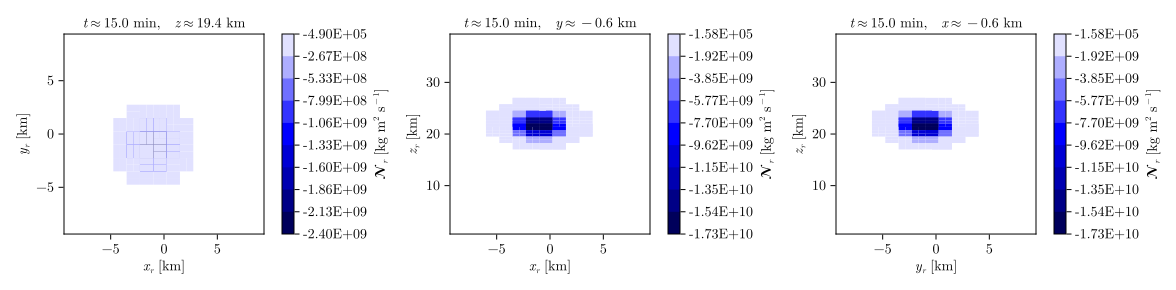
Instead of a contour plot, the above script generates a scatter plot that visualizes the ray volumes, with the color representing the value of the phase-space wave-action density (see below).
WKB wave packet
The function
# src/Examples/wkb_wave_packet.jl

function wkb_wave_packet(;
    x_size::Integer = 16,
    y_size::Integer = 16,
    z_size::Integer = 32,
    npx::Integer = 1,
    npy::Integer = 1,
    npz::Integer = 1,
    output_file::AbstractString = "wkb_wave_packet.h5",
    prepare_restart::Bool = false,
    visualize::Bool = true,
    plot_file::AbstractString = "examples/results/wkb_wave_packet.svg",
)
    lx = 20000.0
    ly = 20000.0
    lz = 40000.0

    parameters = (
        k = 16 * pi / lx,
        l = 16 * pi / ly,
        m = 32 * pi / lz,
        rx = 0.25,
        ry = 0.25,
        rz = 0.25,
        x0 = 0.0,
        y0 = 0.0,
        z0 = 20000.0,
        a0 = 0.05,
    )
    (; k, l, m) = parameters

    model = :Compressible
    background = :Realistic
    coriolis_frequency = 0.0001

    atmosphere = AtmosphereNamelist(; background, model, coriolis_frequency)

    domain = DomainNamelist(; x_size, y_size, z_size, lx, ly, lz, npx, npy, npz)

    output = OutputNamelist(;
        output_file,
        save_ray_volumes = true,
        prepare_restart,
        output_interval = 900,
        tmax = 900,
    )

    state = State(Namelists(; atmosphere, domain))

    wkb = WKBNamelist(;
        wkb_mode = :MultiColumn,
        initial_wave_field = (alpha, x, y, z) -> (
            k,
            l,
            m,
            omega(state, parameters, x, y, z),
            wave_action_density(state, parameters, x, y, z),
        ),
    )

    integrate(Namelists(; atmosphere, domain, output, wkb))

    if visualize && MPI.Comm_rank(MPI.COMM_WORLD) == 0
        h5open(output_file) do data
            plot_output(plot_file, data, ("nr", 8, 8, 16, 2); time_unit = "min")
            return
        end
    end

    return
end
initializes an unresolved gravity-wave packet (i.e. one that is parameterized by MS-GWaM) in the stratosphere of a "realistic" compressible atmosphere (isentropic troposphere and isothermal stratosphere) and visualizes the resulting ray-volume distribution after fifteen minutes integration time (see below). Like the wave-packet script discussed above, it constructs an auxiliary state and uses helper functions to satisfy the gravity-wave dispersion and polarization relations.
Wave-packet helper functions
The Examples module contains another module called WavePacketTools, which provides the helper functions
# src/Examples/WavePacketTools/ijk.jl

function ijk(state::State, x::Real, y::Real, z::Real)::CartesianIndex
    (; lref) = state.constants
    (; grid) = state

    i = argmin(abs.(x .- grid.x .* lref))
    j = argmin(abs.(y .- grid.y .* lref))
    @ivy k = argmin(abs.(z .- grid.zc[i, j, :] .* lref))

    return CartesianIndex(i, j, k)
end
# src/Examples/WavePacketTools/rhobar.jl

function rhobar(state::State, x::Real, y::Real, z::Real)::Real
    (; atmosphere) = state
    (; rhoref) = state.constants

    @ivy return atmosphere.rhobar[ijk(state, x, y, z)] .* rhoref
end
# src/Examples/WavePacketTools/thetabar.jl

function thetabar(state::State, x::Real, y::Real, z::Real)::Real
    (; atmosphere) = state
    (; thetaref) = state.constants

    @ivy return atmosphere.thetabar[ijk(state, x, y, z)] .* thetaref
end
# src/Examples/WavePacketTools/n2.jl

function n2(state::State, x::Real, y::Real, z::Real)::Real
    (; atmosphere) = state
    (; tref) = state.constants

    @ivy return atmosphere.n2[ijk(state, x, y, z)] ./ tref .^ 2
end
# src/Examples/WavePacketTools/envelope.jl

function envelope(parameters::NamedTuple, x::Real, y::Real, z::Real)::Real
    (; k, l, m, rx, ry, rz, x0, y0, z0) = parameters

    r =
        sqrt(
            (rx * k * (x - x0))^2 +
            (ry * l * (y - y0))^2 +
            (rz * m * (z - z0))^2,
        ) / pi
    if r <= 1
        return (1 + cos(pi * r)) / 2
    else
        return 0.0
    end
end
# src/Examples/WavePacketTools/phi.jl

function phi(parameters::NamedTuple, x::Real, y::Real, z::Real)::Real
    (; k, l, m) = parameters

    return k * x + l * y + m * z
end
# src/Examples/WavePacketTools/omega.jl

function omega(
    state::State,
    parameters::NamedTuple,
    x::Real,
    y::Real,
    z::Real,
)::Real
    (; coriolis_frequency) = state.namelists.atmosphere
    (; k, l, m) = parameters

    return -sqrt(
        (n2(state, x, y, z) * (k^2 + l^2) + coriolis_frequency^2 * m^2) /
        (k^2 + l^2 + m^2),
    )
end
# src/Examples/WavePacketTools/bhat.jl

function bhat(
    state::State,
    parameters::NamedTuple,
    x::Real,
    y::Real,
    z::Real,
)::Real
    (; a0, m) = parameters

    return a0 * n2(state, x, y, z) / m * envelope(parameters, x, y, z)
end
# src/Examples/WavePacketTools/uhat.jl

function uhat(
    state::State,
    parameters::NamedTuple,
    x::Real,
    y::Real,
    z::Real,
)::Number
    (; coriolis_frequency) = state.namelists.atmosphere
    (; k, l, m) = parameters

    return n2(state, x, y, z) == 0.0 ? 0.0 :
           1im / m / n2(state, x, y, z) *
           (omega(state, parameters, x, y, z)^2 - n2(state, x, y, z)) /
           (omega(state, parameters, x, y, z)^2 - coriolis_frequency^2) *
           (
               k * omega(state, parameters, x, y, z) +
               1im * l * coriolis_frequency
           ) *
           bhat(state, parameters, x, y, z)
end
# src/Examples/WavePacketTools/vhat.jl

function vhat(
    state::State,
    parameters::NamedTuple,
    x::Real,
    y::Real,
    z::Real,
)::Number
    (; coriolis_frequency) = state.namelists.atmosphere
    (; k, l, m) = parameters

    return n2(state, x, y, z) == 0.0 ? 0.0 :
           1im / m / n2(state, x, y, z) *
           (omega(state, parameters, x, y, z)^2 - n2(state, x, y, z)) /
           (omega(state, parameters, x, y, z)^2 - coriolis_frequency^2) *
           (
               l * omega(state, parameters, x, y, z) -
               1im * k * coriolis_frequency
           ) *
           bhat(state, parameters, x, y, z)
end
# src/Examples/WavePacketTools/what.jl

function what(
    state::State,
    parameters::NamedTuple,
    x::Real,
    y::Real,
    z::Real,
)::Number
    return n2(state, x, y, z) == 0.0 ? 0.0 :
           1im * omega(state, parameters, x, y, z) / n2(state, x, y, z) *
           bhat(state, parameters, x, y, z)
end
# src/Examples/WavePacketTools/pihat.jl

function pihat(
    state::State,
    parameters::NamedTuple,
    x::Real,
    y::Real,
    z::Real,
)::Number
    (; kappa, rsp) = state.constants
    (; m) = parameters

    return n2(state, x, y, z) == 0.0 ? 0.0 :
           kappa / rsp / thetabar(state, x, y, z) * 1im / m *
           (omega(state, parameters, x, y, z)^2 - n2(state, x, y, z)) /
           n2(state, x, y, z) * bhat(state, parameters, x, y, z)
end
# src/Examples/WavePacketTools/wave_action_density.jl

function wave_action_density(
    state::State,
    parameters::NamedTuple,
    x::Real,
    y::Real,
    z::Real,
)::Real
    (; k, l, m) = parameters

    return n2(state, x, y, z) == 0.0 ? 0.0 :
           rhobar(state, x, y, z) / 2 *
           omega(state, parameters, x, y, z) *
           (k^2 + l^2 + m^2) / n2(state, x, y, z)^2 / (k^2 + l^2) *
           bhat(state, parameters, x, y, z)^2
end
that implement the gravity-wave dispersion and polarization relations needed for the initialization of wave packets.